Ella Fitzgerald: The First Lady of Song
Who was Ella Fitzgerald?
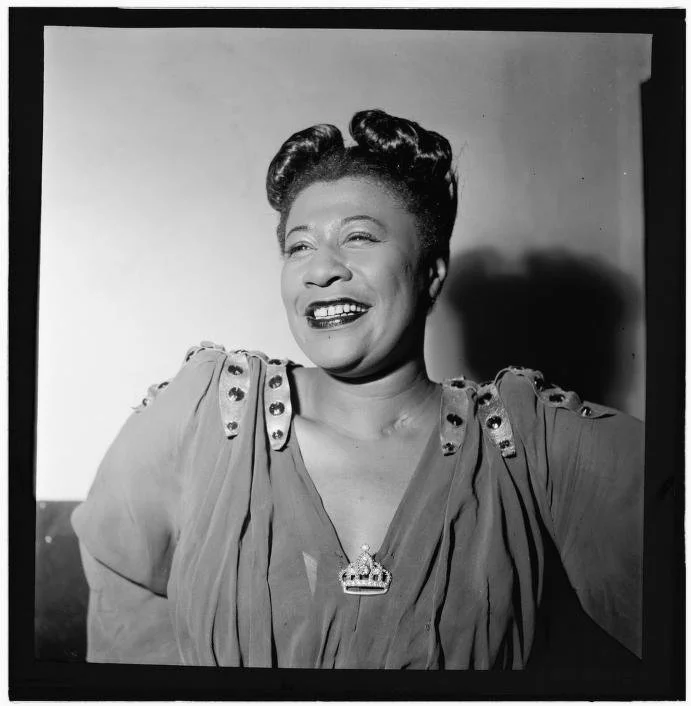
Ella Fitzgerald is widely regarded as one of the greatest jazz singers of all time. Known as “The First Lady of Song,” she possessed a voice of extraordinary purity, precision, and flexibility.
Her technical mastery was unmatched, she had impeccable diction, a perfect timing, and an incredible ear. She also had absolute pitch and a unique ability to improvise, often using her voice like an instrument.
But beyond technique, what made Ella unforgettable was her ability to tell a story through music.
A difficult beginning
Ella Fitzgerald’s life began far from the spotlight. Born in 1917, she faced instability and loss from an early age.
Her father left when she was just three, and by fourteen she had lost her mother in a car accident. Struggling with poverty, she drifted away from school and fell into difficult circumstances, including working as a lookout for a bordello.
After being detained and sent to a reformatory school, she eventually escaped and ended up living on the streets of Harlem, where she earned pennies dancing on street corners.
The night that changed everything
At 17, Ella Fitzgerald entered Amateur Night at the Apollo with a few friends, almost as a bet. She had intended to dance, but after watching the Edwards Sisters take the stage, she knew she could not follow them. So at the last moment, she chose to sing instead.
She began with Hoagy Carmichael’s “Judy,” then answered the audience’s cheers with an encore, singing “The Object of My Affection.” She won the contest that night and took home $25 —money she would later laughingly call the hardest she had ever earned.
The Apollo did not make her an instant star, but it made people notice. Soon, word was circulating through Harlem about a young girl who could really sing.
From swing to stardom
A few weeks later, singer Charles Linton was asked to find a female vocalist for Chick Webb’s orchestra, and he brought Ella Fitzgerald to his attention. At first, Webb was unconvinced. In front of him stood a shy, poorly dressed teenager who hardly looked like a future star. But the moment Ella began to sing, his doubts disappeared. He immediately recognized something rare.
That encounter became her first true opportunity, and the turning point that began to lift her out of poverty.
Under Webb’s mentorship, Ella quickly evolved. She developed not only her voice, but also her confidence, her style, and her stage presence, laying the foundation for the artist she would soon become.
Her breakout hit, “A-Tisket, A-Tasket,” made her a national sensation. Between the mid-1930s and early 1940s, she recorded extensively up to 150 songs and became one of the defining voices of the swing era.
When Webb died in 1939, Ella took over the big band, a rare and remarkable role for a young woman at the time.
The birth of scat and bebop
As jazz entered a new era in the 1940s, marked by the rise of bebop and more complex musical structures, Ella Fitzgerald evolved right alongside it. Rather than remaining within the boundaries of traditional swing, she embraced this transformation with remarkable curiosity and creativity. Working with visionary musicians like Dizzy Gillespie, she refined and popularized her now-iconic scat singing — a style that turned her voice into a true instrument.
Through scat, Ella didn’t just sing melodies; she improvised, weaving intricate patterns of sound that mirrored the spontaneity of a trumpet or saxophone. Her phrasing, timing, and rhythmic precision allowed her to engage in a musical conversation with the band, blurring the line between vocalist and instrumentalist.
She once explained her approach with characteristic simplicity:
“I just tried to do with my voice what I heard the horns in the band doing.”
What sounded effortless was in fact the result of extraordinary musical intelligence and instinct. This ability to improvise with such freedom and accuracy positioned her at the forefront of jazz innovation, making her not just a great singer, but a true pioneer of vocal expression in the genre.
The Songbook era: elegance and mastery
A major turning point in Ella Fitzgerald’s career came through her collaboration with producer Norman Granz, whose vision would help elevate her artistry to an entirely new level. Under his guidance, Ella embarked on one of the most ambitious recording projects in jazz history: the legendary Songbook series.
These albums were dedicated to the greatest composers of the American song tradition, including George Gershwin, Cole Porter, and Duke Ellington. Rather than simply performing these songs, Ella reinterpreted them with unmatched clarity, emotional nuance, and vocal precision.
Her voice during this period reached a new level of refinement, warm yet controlled, expressive yet never excessive. She brought out the storytelling within each lyric, giving new life to songs that audiences thought they already knew.
Around the same time, an unexpected ally helped change the course of her public career: Marilyn Monroe. Monroe famously supported Ella in securing a booking at the Mocambo nightclub in Hollywood, a venue that had previously excluded Black performers. The engagement was a turning point, introducing Ella to a broader and more mainstream audience.
Reflecting on that moment, Ella later said in an interview:
“After that, I never had to sing in a small jazz club ever again.”
It marked her transition from celebrated jazz vocalist to international star.
A life of collaborations
Ella Fitzgerald’s career was not only defined by her solo brilliance, but also by the extraordinary artists she collaborated with. She had a rare ability to adapt her voice to different musical settings while still maintaining her unmistakable identity.
Her duets with Louis Armstrong remain among the most beloved recordings in jazz history, blending her smooth clarity with his gravelly warmth in a way that felt both contrasting and perfectly balanced.
She also worked closely with the orchestras of Count Basie and Duke Ellington, where her voice soared over rich, dynamic arrangements.
Later in her career, she explored more intimate formats, notably in her recordings with guitarist Joe Pass, where the stripped-down instrumentation highlighted the purity and subtlety of her voice.
With pianist Oscar Peterson, she engaged in true musical dialogue, performances that felt spontaneous, playful, and deeply connected.
Her artistic curiosity also led her beyond American jazz standards. In her tribute to Brazilian composer Antônio Carlos Jobim, she demonstrated once again her remarkable ability to move seamlessly across genres, embracing new rhythms and cultural influences without ever losing her essence.
Breaking barriers
Behind the elegance and success, Ella Fitzgerald’s journey was shaped by the harsh realities of racial segregation in mid-20th-century America. As a Black woman, she faced discrimination that extended far beyond the stage, from being denied hotel rooms to encountering segregated venues that limited where she could perform.
Despite her growing fame, these obstacles remained a constant presence in her life. Yet Ella responded not with confrontation, but with quiet resilience and unwavering professionalism.
With the support of Norman Granz, she made a clear stand: she would only perform in venues that treated all musicians equally. Granz himself was known for refusing to tolerate segregation, and together they helped challenge discriminatory practices within the music industry.
Ella did not deliver political speeches or position herself as an activist figure. Instead, she let her artistry speak, and it spoke powerfully. Night after night, performance after performance, she demonstrated a level of excellence that audiences and institutions alike could not ignore.
Her success became, in itself, a quiet but profound form of resistance.
A timeless legacy
Over the course of her career, Ella Fitzgerald received 13 Grammy Awards and recorded close to 200 albums, with a repertoire of more than 2,000 songs. These numbers are impressive, but they only hint at the true scope of her impact.
Her influence can be heard across generations of singers, from jazz vocalists to contemporary artists who continue to draw inspiration from her phrasing, tone, and improvisational freedom.
What makes Ella truly timeless is not just her technical brilliance, but the emotional clarity and joy she brought to every performance. Her voice had the rare ability to feel both sophisticated and accessible — capable of dazzling complexity, yet always grounded in sincerity.
Even today, decades after her peak, her recordings remain as vibrant and moving as ever.
